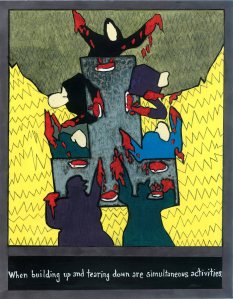
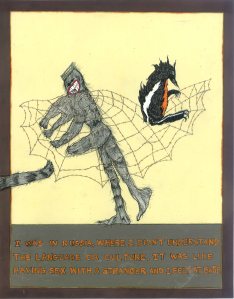
A game of skeeball costs a nickle. My father pays. You grasp a blue or yellow ball with the paint chipped off and toss it up to rings for coupons, aiming at the highest, smallest ring for the most coupons. The ball is bigger than my fist. The air smells of ocean. The waves roll in like skeeballs returning from a toss. The bullfrog who rules the arcade speaks with a friendly rasp, and his apron, tied tight around his middle, jingles with coins. My sister is in another lane, older and beautiful. I want enough coupons to buy the lamp with the rattan shade or the noisy clock that sits on a dusty shelf. I want never to leave the boardwalk, the cotton candy, the drawing sensation of the Tilt-a-Whirl I will later know is sex. One day I hold in my pee too long, and for a moment my father looks confused and almost laughs before saying, “Just go.” I am under the moon and stars on a dark stretch of boardwalk, and warm pee is sliding down my legs. Then my father says, “Run,” and we are running as I am still peeing, and my sister is beside me with a devil face.
Jaquar
The things we have said and will say are changed by present political reality. I wrote this many years ago. It seems about now.
I knew a man who drove a Jaguar. I would not let him pay for me, and he would not eat in the places I could afford. I was fascinated by his having so much. He was fascinated by my having so little. He said, “I know what you like to do in bed,” and I became aroused, although you would not think so to look at him. He tore the strap of my dress in his car. Otherwise he was uninteresting.
From notebooks: running in war and End Times
From my notebook, spoken by a war correspondent I was having coffee with: “Running in a war, you hear explosions, and you ask yourself, “Am I still alive?” It is your only thought, and you see how unnecessary all the other thoughts are. For a while you are drunk on adrenalin. When that wears off, you think you have transcended the parts of life that are burdensome. When that stage passes, you see it is another captivation and that there are endless levels you are never going to get free of.”
From a notebook entry: Richard has been writing about presentism, a way we live now, no longer believing history expresses a narrative of progress or improvement. We are squeezed into the now by intimations of apocalyptic end times. These times are ushered by political calamity and environmental collapse. In presentism, we experience a continual now of moments that are more like a stuck record or a stuck CD than like a chain of moments that lead to their futures and produce their histories. And yet contained in the space of these moments are all the spaces of time that has come before and all of our predictions about the future devised from the perspective of the past. The mind produces elsewheres and elsewhens, a form of time travel that isn’t observable, like the time/space continuum itself. In apocalyptic apprehension, we live all the parts of our lives simultaneously, like Dave in the end room in 2001, a Space Odyssey, and these lives are nested inside each other like Russian dolls. In the sense now I feel of everything I have known ending, I am the Laurie who walked the streets of Long Beach as a child, although I could have riden my bike, in order to think the thoughts of a walker. I am the Laurie who made homes in other people houses until she had outstayed her welcome. And on. According to Frank Kermode in The Sense of an Ending, the apocalypse can be endlessly disconfirmed without being discredited. We go on believing we are living in end times, a destabilizing constant state that produces, casuistically, more anticipated end times–permanent end times. A way out? Face our past with truth and commit to a more equitable future.
Fear of Contamination
Dear humans, after 9/11, 2001, I wrote a piece called “Risk of Contamination” for Brendan Lemon, who was then the editor of Out Magazine. In the essay I compared the way fear of the female body as a contaminating agent of maleness operated in both western and eastern philosophies and practices. I said a crisis in the concept of masculinity in both the east and the west was endangering the world, and I said this crisis in the concept of masculinity linked geo-political factions that otherwise saw themselves as enemies.
I feel a need to review these ideas and make them available to anyone interested. This post is drawn from excerpted pieces I have written and email exchanges with friends. I’m providing it as a resource. Please do not debate me on this post. I am not a debater, and I will delete you. You are free to write what you want on your posts and debate there. Please do not mansplain to me about how I don’t understand race and class or whatever else you do not think I understand. If I want mansplaining, I can look in the mirror. Please do not ask me to explain humor. FYI: I have included a review of Spielberg’s “A.!.,” with many relevant themes, at the end of the post.
My focus is on misogyny, sexism, gynophobia, and patriarchy. I am going to speak about the psycho-dynamics of world events, the way phobias operate at an unconscious level and how individuals and societies disavow knowledge even as it forms in front of their faces. These thoughts critique essentialism—the notion that any identity has an essential (ordained, natural, universal, unchanging) character. I do not believe the identity of anything is fixed. It changes. It is mixed. It has always been mixed. “The natural” is a human construction. As soon as human beings learn something, it feels like we have always known it. That is the way “the natural” is born. If nothing is essential, nothing is pure. It never was. I will also be touching on “decline-and-fallism,” the notion that the present is a debased version of a previous golden age (when things were pure). Make American Great Again. That kind of thing. There is a long history of this thinking. It is called “negative classicism.” Patrick Brantlinger wrote a brilliant book about the history of negative classicism in Bread and Circuses, Theories of Mass Culture As Social Decay.
The concept of “maleness” is defined in all religions and in the societies shaped by religions as “not female.” In religions and other ideologies of enforced, gendered power, the function of perceived femaleness is to comment on maleness. In these thought structures, femaleness is a contaminating agent that must be kept separate from maleness, lest it pollute and degrade maleness. How do you keep it separate? You confine and control the female body, especially the sexual female body, in public and private space. You determine whether it can freely engage in sexual behavior. You maim and kill it if it expresses desires that threaten the sovereignty of males to control it. You attach notions of honor and purity to it that constrict and sometimes destroy it. You determine it must be draped and shorn to limit its sexual power over males. You outlaw abortion. No one cares about unborn embryos. They care about organizing the female body’s social role.
Here is the kicker. The practitioners of the most orthodox and rigid ideologies of male supremacy suspect maleness is already hopelessly contaminated. They know in some part of their half-conscious minds that if there were really such a thing as an essential male nature and an essential female nature, none of this policing would be necessary. The fear of contamination becomes a symptom that the contamination has already occurred and that people are hopelessly mixed. Fascism and other forms of totalitarianism are the shit-storm tantrums released when knowledge is simultaneously registered and disavowed. It is the crazy inside doublespeak and doublethink.
Every fascist and totalitarian regime immediately legislates to control the female body and force it to comply with its perceived biological function as a way to reinstate all forms of control and order. This is symbolic and also believed to be a practical remedy for social unrest. The out-of-control female body, in polluting everything, incites all reversals of ordained divisions of power. Outlaw abortion, and the poor will abandon their unions. If that doesn’t actually work, make poor people poorer.
All the other hatreds that exist around the perceived contamination model operate on the same system as the gender binary, so you could say they are modeled on this central hatred. You do not end misogyny, sexism, gynophobia, and patriarchy by addressing race, economics, class, ethnicity, and cultural diversity, because hatred of the female operates in all of these other systems as well. You might get rid of racism, homophobia, etc. by addressing what is at the heart of the gender binary and its false definitions of what a male person is, what a female person is, and what a person of mixed sex identity is. Only female humans are reviled entirely on the basis of being female . . . male humans are reviled for an aspect of their perceived identity that is separate from their identity as male humans . . . i.e. black males, Latino males, gay males, disabled males, Muslim males. I am in no way saying the injuries of racism are less horrendous than the injuries of misogyny. Included in the injuries of misogyny and sexism is that women are the only humans who actively militate against their own increased freedom and mobility. Who does something like that? A large number of white women voted for Trump, maybe not the disputed 53% statistic, but many.
The following comments on race evolved in a conversation with a friend who wanted to compare race and gender hatreds. This is from my email: We now know race is entirely a social construction without biological validity, and we know that around 60,000 years ago the homo sapiens we all evolved from moved out of Africa and across the globe. I think there may come a time in the future when so-called white people will no longer exist. Humans will all be mixed and their skin colors different and darker shades. That won’t end prejudice based on skin color, perhaps, but it is an evolving condition, always undergoing transformation. Although race may not be a real and fixed identity, phobias and hatreds around the perception of race difference are definitely real things. The same can be said of homosexuality. Humans do not exist in a homosexual/heterosexual binary, but the reality of homophobia is real. With regard to the male/female binary, that, too, is in many ways socially constructed, since there are more than two sex identities. Still, most people are born with either female or male sexual characteristics, and on to this binary has been layered a giant philosophy and ideology of difference. I said earlier that in patriarchal cultures, religions, and societies—meaning all the ones that exist now on the planet—maleness is defined as not-female and female is less defined than used as an instrument to comment on maleness. In any binary, there is always a power difference, and when there is a power difference, the group constructed as less powerful is policed, lest its less powerful essence contaminate the group that has power. In the gender binary, the female body is segregated, covered, and ritually cleansed to keep it from physically contaminating the male body and the male sphere, and the female body is maimed, jailed, and murdered for perceived transgressions against its so-called ordained roles. (The idealized female body is a subset of the reviled female body . . . neither is real or has anything to do with what women are and feel themselves to be.)
This model of policed and inferior being is the core model on which all other forms of phobic hatred are based. It is prior, many thousands of years old. Using the term “male” to signify “the powerful” and “female” to represent “the subordinated,” then whiteness is male and blackness is female. Heterosexuality is male and homosexuality is female. Christianity is male, and Jews and Muslims (in the west) are female. Western colonial practices are male, and eastern subordinated countries are female. The deserving wealthy are male, and the undeserving poor are female. All propaganda campaigns of binary hatred use the same slurs to diminish the disempowered and policed group and these slurs are essentially the same as are attributed to females. Jews in Nazi propaganda and people of color in white dominated societies, to name two, are described as hyper-sexual, closer to animals, scheming, untrustworthy, tribal, clannish, disgusting in their social and physical practices, deformed in their physical beings and characters. Hence they must be segregated or destroyed lest they degrade the power body which is always at risk of mixing, miscegenation, contact, etc. and thus weakening the pure. So what I am saying is not that all women have it worse in society and culture than other oppressed people. Not by a long shot, depending on class, skin color, economic opportunities, etc. I am saying gynophobia and the misogynist and sexist practices that issue from it is the blueprint for all hatreds shaped by binary thinking and binary levels of oppression and double standards. What we are seeing in this country now is a violent reaction to the success of a black president and the candidacy of a female running for office. Trump has given white, heterosexual, unhappy male humans a forum to express the way they have been made to feel their power curtailed. White heterosexual male privilege is not supposed to know it exists. It is supposed to be taken for granted by everyone. It is supposed to be understood as natural, even to the people still moving in the world with that assumption, and yet this has changed. It has been challenged. It has been turned into a thing for contemplation, not a component of nature and of the natural. At least this has happened.
To see how I used some of these ideas in a piece of art criticism, here is an excerpt from a review I wrote about A.I. originally published in Tikkun.
From a review of Steven Spielberg’s A.I. (2001), a film about the rise of Nazism:
Steven Spielberg’s “A.I.” is a messy concoction of startling and plodding ingredients, but in moments of originality, it boldly grapples with fears of otherness. . .. The film comes alive in the middle section when we are introduced to Gigolo Joe, played by a radiant Jude Law. Joe is a robot designed as an ardent sex partner, and he is the most charged and canny presence on screen. In this section, too, Spielberg presents a wise and witty gloss on decline-and-fall thinking and the scapegoating of perceived cultural polluters. “A.I.” depicts a dystopia that is a consequence of our failures. Due to the misuse of Earth’s resources, the ice caps have melted, coastal cities are submerged, and the population has become tightly controlled, hence the need for robot children. At this point, robots, known as mechas, have become so advanced many are indistinguishable from humans, called orgas. The ranks of mechas have swelled because they labor without food. But although created to serve orgas, mechas are hunted and ritually tortured in gatherings called Flesh Fairs.
The film is shot almost entirely from the perspective of mechas. David and Joe are captured and caged, and we see a Flesh Fair through their eyes. The atmosphere is part rock concert, part Nuremberg rally. The audience is a mob, whipped to a frenzy by a promoter’s rhetoric of race hatred and ethnic cleansing. “This is a commitment to a truly human future,” he brays, as buckets of acid eviscerate and liquefy sacrificial mechas. He swears by “the law of blood and electricity.”
Gripping and sly, these scenes illuminate the mechanics of dread. The fear is of contamination, some sort of pollution seen to have a diluting, enervating effect on a group that considers itself whole and defined by essential and fixed characteristics. Castration anxiety, in other words. The threat of contamination is perceived to be from outside. All campaigns of hate against perceived others and all laws against miscegenation are based on the notion of a purity at risk of becoming degraded. In this understanding, the invigorating effects of hybridization aren’t valued, if they’re even recognized. Rather, mixing is imagined as a decline and fall. In the mind of the person who sees such threat, a sentence keeps looping: “Things used to be better, but now the times are sick, and the infection has to be cut out.”
The film shows there is never a time when this fear isn’t ticking away, because as soon as the idea of purity is formed, worry forms about its fragility. As soon as there is worry, it feels like proof that the contamination has already occurred, so in the minds of purists, the present is always a time when things are worse than they were in an imagined, safer past. Fear of otherness is a forceful denial that dilution has occurred, because the secret belief is, indeed, it has.
The orgas are aware that the boundary between what characterizes them as human and what defines mechas as nonhuman is continually shifting. “I’m real,” an orga child taunts David, as the boy, recently resuscitated from a cryogenic coma, clomps around with prosthetic devices on his legs. Amid a dump site filled with extinguished mechas, damaged mechanical beings rummage for replacement parts, attaching a new arm or jaw with an ease that humans awaiting organ donations can only long for. On a wall in the building where David is fabricated is a painting depicting “The Emperor’s New Clothes,” a fable about the power of mass suggestion and the difficulty of acknowledging reality that is staring you in the face.
Who are we now? The mapping of the human genome, the increasing miniaturization of computer chips, research into brain function, and advances in robotics—all these promise increasingly intelligent, sentient machines, some of which will aid human beings by mixing with and penetrating them. Implantable devices are in the works that will enable blind people to process visual images and people with spinal cord injuries to use their leg muscles. Does anyone consider the heart patient now living with a mechanical ticker and people with other prosthetic devices less human? Today, amputee runners, outfitted with titanium legs, can outstrip sprinters with flesh-and-bone limbs. The metal legs don’t look like human legs and aren’t trying to imitate them. They are beautiful according to their own aesthetic. The freak over there has always been inside us.
3AM Magazine review of Animal
3:AM Magazine
home reviews essays interviews fiction poetry blog submissions twitter
:: article
urban fauna: a review of my life as an animal
By Joan Hawkins.
Laurie Stone, My Life as an Animal (Northwestern University Press, 2016)
When My Life as an Animal was published last fall, Largehearted Boy invited its author, Laurie Stone, to post a playlist for the book. She programmed Leonard Cohen and Bob Dylan sliding right into Bach’s Goldberg Variations. It’s a telling accompaniment to a story collection that shifts register and tone, upends genres, and challenges reader expectations, all without losing the reader’s trust. Animal belongs to what Stone has called “Third Narratives”—something between fiction and non-fiction that incorporates techniques “drawn from novels and short stories, memoir, cultural criticism, essays, journalism and photography.” It’s a hybrid text, a mongrel form. It engages memoir, in the sense that it is a book composed of life-events and fragments. But it incorporates the narrator’s intellectual life as well. And so there are lovely lengthy passages talking about Jewish history, Beckett, W.G Sebald, cellular biology, museums and the sculpture of David Nash.
“We who write poetry,” Eileen Myles once wrote, “and think about it all the time—who walk the streets that other humans walk, past pizza stands and trees, are citizens meanwhile of another country,” a country where everything—the most random encounter, the most banal of tasks—becomes grist for the mill. Writers are always writing, and Stone’s achievement lies in vividly showing how that is true for prose writers as well as poets.
Some of the stories are long, moving gracefully between present and past lives. Some are quite short, a few pages, that operate like brief shot sequences (rather than fully fleshed out scenes) within the larger movie of the narrator’s life. For me, the long pieces in the volume are the more satisfying, but that may well be part of Stone’s strategy. There’s an element of bricolage here, a sort of do-it-yourself construction (the original handy-man meaning of bricolage). Animal is a work built from the ground up, out of scraps, and bricolage is perhaps the perfect literary mode for discussing one’s life, because that’s what life is—a DIY edifice made from found fragments, assembled with creativity, courage and brio. Since the volume aims to call attention to what we think we want from a story, the short pieces remind us that life is never one long, unbroken narrative, but filled with moments, mere snapshots of events and people we’re not sure advance the larger narrative of our lives.
Borrowing from cinematic montage, the book’s structure uses linkage and juxtaposition, allowing each narrative to comment on the ones preceding and succeeding it. The stories can be read independently of the others, but the full impact comes only at the end, once all the stories have been experienced. And as in montage, the effect here is not of smoothing out contradictions into one homogenized whole of a life, but rather that of a collision, which creates meaning through fission. What Stone’s narrator is looking for is not absolute truth but rather the “narratively right”—meaning, “the relief of patterns.”
Stone’s narrator is smart, funny, well spoken, and complex. Prickly, too. She finds her way in life, and in these stories, by challenging ideas and arguing with those close to her. If you’re looking for a sweet cozy of a tale about a 60-year-old woman falling in love and moving to Arizona, you need a different book. There is a sweetness here. But like fleur-de-sel chocolates, it’s complicated with an edge of salt—a fierce and demanding intelligence. Animal is the perfect book for that corner café table that Patti Smith writes about in M Train, where you read and reread books until you get the hang of their logic.
If you have the time, try to read this book in one long sitting, perhaps two. The montage effect is at its most pronounced in the first half of the book, and it’s best not to let too much time elapse between reading those stories. Animal opens in medias res: a 6o-something writer (I will call her L. to distinguish her from the author) has fallen in love with Richard, a 56-year-old professor of museum studies, and has moved to Arizona to be with him. In the first story, she haunts garage sales, looking for the items they need to furnish their new home, and setting out, in the process, many of the themes that recur across stories. L. doesn’t see what her lover Richard sees. “It is one of the reasons I like floating along beside him,” she says. But it’s also a source of tension throughout the book. She’s American; he is English. She’s Jewish; he is not. She avidly collects stories, easily falling in love, she says, with strangers who look interesting or make a connection. He’s more reserved, less in the moment. “You two will always fight,” L.’s friend, Catherine, says. And L. agrees, citing a deep ambivalence at the heart of real love. “With us it is always, ‘Do you love me as I am?’ And the answer is ‘Yes and no.’ We are of two minds. We half-believe.”
From here, the stories fan out, drawing from different parts of L.’s life. Sometimes they explicitly reconnect with Richard, with Arizona, with the present. Sometimes they’re there to show us how L. came to be the person who would, at the age of 60, cast caution to the wind one more time. “I believed this kind of thing would not happen to me again,” she says. But “when has anything you thought about the future turned out right?”
In “Sixty,” she tells us, she met Richard at Yaddo, the artist colony in Saratoga Springs. At the end of their stay there, they drive to the airport and can’t find the entrance. “It’s a sign I shouldn’t leave,” he tells her. But he’s married. And when he gets home, he will tell his wife of many years that he has met someone. “Richard says he did not leave his marriage for me,” the narrator tells us. “He says Yaddo cracked him open.”
She could have left it there. But she doesn’t. “We believe what we believe,” she tells us, implying that Richard may be deceiving himself. And in a story that is also about Kate Millett and the early days of Second Wave feminism, she ends on a note that is honest and politically incorrect. “I am on a train a year later,” she writes, “and run into a woman I slightly know. I tell her about Richard, and she says, ‘How could you let him leave his wife?’” The woman “does not sound judgmental,” L. tells us, “more like a naturalist asking a scorpion how pincers work. I say, ‘Richard decided,’ but she knows I did not put a gun to his head, and I know I did not say, ‘Stop,’ because he might have listened to me.”
“If you think there is a part of you that makes you unlovable,” she writes earlier, “you will protect it like a child and show it to everybody.” One of the deep strengths of this book is its refusal of what Sartre called bad faith. The narrator trusts the reader’s intelligence enough to speak bluntly about the things we often try to camouflage. After all, who hasn’t, at one time or another, played the scorpion? Who wouldn’t be willing to do so, if the right person stood at the end of a ramp, “looking like an arrow with his slim body and silver hair, and the hard little spike that holds [us] up just melted.”
One of the brilliant maneuvers in this not-quite-romantic romance is to place the sobering story “Leaving Gardner” at approximately the halfway mark. It’s a story that marks a complicating turn in the larger narrative. In her thirties, L. fell in love with Gardner, an artist 20 years her senior. When she was 44, he died of cancer, after a terrible struggle that Stone describes as only she can. “There is something about language,” she writes later in the book, “that hurts the thing it describes.” Usually I would agree with her, but not in this instance. Describing the cancer-ravaged body of her beloved, L. speaks in a way that filmmaker Trinh T. Minh-ha has called speaking nearby. Speaking nearby is different from speaking about, in that it allows the person or the thing described to have its own voice. For those of us who have loved and lived with people who died of cancer, the final days are marked with the disease’s own very clear narrative. Cancer’s voice, when you hear it, is quieter and less obscene than the demon in The Exorcist, but no less insistent on gaining total possession of your body. It is that voice that is caught here.
The story reminds the reader just how great a leap the now 60-something L. is making. When you fall in love at 20, at 30, at 40, you can believe in happily-ever-after. By the time you’re 60, and have lost both your parents, a lover, and countless friends, you know that there can be no forever. If the relationship works out, if you get your Secret Agent Lover Man, and if you don’t die together in a car accident, a bomb explosion, or a natural disaster, then one of you will have to watch the other die. And that awareness is fundamentally alters the political economy of love. “We fall in love with people we don’t pick, not really,” L. tells us. “Love falls over you like a weather condition, a wolf’s paw, a cape.” But when it happens at 60, it takes a lot of courage not to run away as fast as you can. This story, and the collection as a whole, reminds us of what the diamond ads and Disney movies fail to tell us about what love really is: an existential crisis, an engagement without appeal.
ABOUT THE AUTHOR
Joan Hawkins is an associate professor of cinema and media studies in the Media School at Indiana University. She has written extensively on horror and the avant-garde. Her books are Cutting Edge: Art-Horror and the Horrific Avant-garde and Downtown Film and TV Culture 1975-2001. She is currently co-editing an anthology on William S. Burroughs.
Back to top
The Page 99 Test
The Page 99 Test: Laurie Stone & MY LIFE AS AN ANIMAL
Posted on December 28, 2016 by HEAVY FEATHER Leave a comment
The Page 99 Test: Laurie Stone & My Life as an Animal
“Open the book to page ninety-nine and read, and the quality of the whole will be revealed to you.” ―Ford Madox Ford
Damn you, Ford Madox Ford. I wanted to be done with a friend I had turned into a character in My Life as an Animal. Then I read page ninety-nine, and there she was in an armchair, talking about love and work, as if no time had passed.
She was older than me, more accomplished, a little famous. We were close half a lifetime ago. Really, half a lifetime ago in the women’s movement. She was significant at a turning point, or maybe all the times you love someone and lose them are turning points. When I knew her, I was with a man named Gardner, who became ill with bone marrow cancer. Near the end, I was taking a break from the hospital and sitting in a coffee shop with my friend. I was flattered she had come and hanging on her words as if they were directions to a new life. I liked to watch her mouth hesitate and curl as the words formed. I did not know Gardner was taking his last breaths.
I resurrected the friendship in a story called “Leaving Gardner” that cuts between his illness and my my-life-as-an-animalfriend. I call her Evelyn. The events on page ninety-nine take place twenty years after Gardner’s death, when the narrator, having arranged a reunion at Evelyn’s apartment, feels their old camaraderie spark to life. Evelyn speaks about her loneliness, and the narrator feels tenderness and admiration. It is as if everything is permissible if it is from the heart. The narrator recalls her own adjustment to aloneness, remembering the movie Henry and June and its depiction of an affair between Anaïs Nin and Henry Miller. In the last scene, Nin weeps, ostensibly about the loss of love, but the narrator remembers thinking—and it came like a revelation about herself—No, you are crying because Henry is a better writer than you, and he is a better writer because he lives without a safety net.
Every memory rewrites the present might be the motto of My Life as an Animal. The stories are autobiographical, but I am not interested in things because they happened. I am interested in whatever I find sexy, scary, surprising, strangely ordinary, or ordinarily strange. Often the book’s narrator drifts toward love that cannot be destroyed because it cannot be fulfilled. She thinks helplessness is funny. At least in retrospect. What links the stories most consistently is the narrator’s direct address to the reader and the changes in her understandings between now and another time.
Evelyn sketches out a book she wants to write about a mutual friend of theirs. The narrator says, “Do it.” Evelyn says, “Why?” The narrator says, “We need books about friendship,” and the narrator thinks about the early days of the women’s movement when everyone would say, “Friends are family.” The narrator does not believe this anymore. She thinks, “Friendship is more delicate. You have to be careful with friends.” She wonders if her connection with Evelyn can continue and at the same time feels the distance they have moved. They no longer know each other’s stories.
I often think about the Lydia Davis story “Happy Memories,” in which the narrator considers what makes a happy memory. She says it requires feeling warmth toward a person who will retain you happily in their thoughts. And it requires that nothing happen subsequently to reverse the good will.
In My Life as an Animal, the narrator leaves Evelyn’s apartment with a feeling of hope. In reality, the friendship foundered again like an animal without legs. I let it go, and then I read page ninety-nine and had a dream.
A performer arrives in the loft where I am staying and sees I have forgotten our plan. I have promised to read with her band, and the audience is restless. Suddenly Evelyn is there, looking younger than in the past, with a sweep of charcoal hair rising up like smoke. I follow her outside, and all the time I am away worry I will not get back. I come to a house where the floor is flooded. I hear a crash and see bodies strewn along a road. It is dark now, and even if I can find a taxi, I will never get back in time. Evelyn smiles, content for us to spend our lives on a futile search for something mysterious. She is across from me on a bed and says, “We should have dinner.” I say, “Did you say you want to be friends?” She says, “Yes.” She leans toward me and places her lips on mine, less a kiss than an intake of breath that feels cold, like air released when a boulder is moved. She clears her throat and kisses me again, twice. These kisses are sexual. And when I wake up I am happy because I will never know myself.
***
Laurie Stone is author of My Life as an Animal (TriQuarterly Books, 2016), the novel Starting with Serge (Doubleday), and the essay collection Laughing in the Dark (Ecco). She is editor of and contributor to the memoir anthology Close to the Bone (Grove). A longtime writer for the Village Voice (1974-1999), she has been theater critic for The Nation and critic-at-large on Fresh Air. She is at work on the fiction collection The Love of Strangers. Her website is: lstonehere.wordpress.com.
New Pages review of Animal
My Life as an Animal
Fiction
Laurie Stone
Northwestern University Press October 2016 ISBN-13: 978-0-8101-3428-7 Paperback 216pp $17.95 Allyson Hoffman
Written in a voice and style reminiscent of memoir, Laurie Stone’s collection of linked short stories My Life as an Animal traces the strengthening and breaking of friendships and family ties in twenty-six stories. The narrator of the stories dances through time—from adolescence to her current life at sixty—and place—New York, Arizona, California, and England. True to life, characters appear and reappear in unexpected ways, affecting others in the past and present.
One character who the narrator often thinks back to throughout the collection is her mother, Toby. Though Toby is imperfect and embarrassing, “She will say someone is ugly when they are close enough to hear,” the narrator loves her. In the story “Toby Dead” the narrator depicts the decline in Toby’s health with humor, as only a loving daughter can:
At eighty-nine, my mother learns her arteries are clogged with plaque like tubes with toothpaste. She brushes off the news and goes into cardiac arrest. A squat little machine that looks like R2-D2 is attached to her by a vacuum cleaner hose, and my sister is holding a clipboard. Ellen is tapping the clipboard with a long, hard fingernail saying, “You have two choices, Ma, sign the form or dead. Which is it, Ma, the form or dead?” I am glancing from the machine to my mother, who looks like a chimp caught in a lab experiment. She trains her beady eyes on Ellen, as if she is being conned, but she takes the pen in her monkey paw and signs on for three more years of life—as well as a stroke and the twenty-four-hour care of home aides.
Some stories in the collection wander in the way an essay might, closely examining an idea as the narrator turns it over and over. Sometimes this examination comes through conversation, such as with the narrator’s boyfriend Richard. Sometimes it’s a combination of conversation and introspection. In the story “Gesche” the narrator meets a pediatric oncologist, and over breakfast the two women discuss the men in their lives.
She took my hand, and I saw green flecks in her eyes. She smiled uncertainly and said, “I don’t take what men say seriously. Men are not their words.”
I thought, If we are not our words, what are we? Then I wondered what we might be apart from words. Gesche was reaching for the everything that does not exist, and I thought, Don’t do it. Don’t give yourself away. Then I thought, Why not?
Stone’s close observation and precise detail also invite the narrator’s essay-like thinking on the page, often in the form of memories:
I remember a poisoned rat that came to die on our patio. Its fur was fluffy, its ears tiny trumpets, its nose a needle, really pointy, with whiskers on either side, delicate as eyelashes. For several hours the rat breathed slowly until finally it fell over, and I thought, Whatever you look at long enough comes to look like you.
Stone also uses these memories to return to other characters in the collection, to show how the past affects the present, decades after the events:
When I was four, in a clothing store I picked out an expensive dress embroidered with strawberries. The sales-woman disapproved of a child so young making the choice. My mother remembered the incident because she told the woman to mind her own business. I remember the story because my mother stuck up for me.
Though some stories, mostly those focused on life in New York City, feel distant and tailored to a particular audience, most stories in the collection are accessible to a wide audience, bringing the readers close to the mind of the narrator as she navigates love and relationships. My Life as an Animal is the perfect choice for readers who enjoy writing that lives somewhere between fiction and nonfiction.
Review Posted on December 01, 2016 Last modified on December 01, 2016
Heavy Feather Review of “Animal”
FREE DIGITAL SUBSCRIPTION
BOOK REVIEWS / FICTION
MY LIFE AS AN ANIMAL by Laurie Stone
Posted on November 9, 2016 by HEAVY FEATHER Leave a comment
my-life-as-an-animal
My Life as an Animal, by Laurie Stone. Evanston, Illinois: TriQuarterly Books, October 2016. 216 pages. $17.95, paper.
My Life as an Animal, a collection of interconnected stories, offers a unified voice and perspective, producing the feel of a loosely constructed novel. While the stories focus on a few topics and themes—Laurie’s relationship with Richard, her family and life in New York City, and her pseudo-exile in Arizona—each topic addresses something within the narrator’s psyche: her connection to strangers, the aging process, and the effects of relocating to the American West. The result is a composite of Joan Didion’s work, where you can’t easily parse fact from fiction, and David Sedaris’s, with its comical explorations of love and family.
Setting is significant in this collection, its presences looming like a significant character. Laurie has lived her entire life in Manhattan. When Richard, her partner, begins work as a professor of museum studies in Arizona, she must decide between her home and the man she loves. Unwilling to give up either, Laurie exists in perpetual state of separation and detachment. As a result she seeks out meaning in objects, landscapes, and strangers. As one of her friends notes, “People are more creative in exile from their physical home.” This is true for Laurie. This motif first surfaces while Laurie travels through an archipelago of yard sales in suburban Phoenix. “I think it is how easily I fall in love with strangers and what they are willing to reveal,” she confesses during her journey from house to house. Like a postmodern flâneur, Laurie drives through the desert, studying her new neighbors in an attempt to understand America. There’s Jeff, who lives in a house with a dirt floor littered with empty pizza boxes and beer cans. He’s high on drugs and admits that he misses his wife, who’s left him. This isn’t voyeuristic. It’s confessional. Jeff needs someone to listen to him and Laurie provides witness. While the idea of the flâneur as a removed entity that floats through the world unconnected, Laurie seems driven toward the presence of others. The physical exile from Manhattan seems to stimulate her awareness of others in a way she could never experience had she stayed in New York.
The American West offers an abundance of nature and solitude. For a New Yorker used to the crowded and busy streets, this change of pace can be difficult to adjust to. City life has defined the narrator’s perception of the world—just being out West challenges Laurie in substantial ways. For example, in the story “Boulder,” she writes about the artist David Nash, who uses found objects in nature to build sculptures. “I become aware I am more interested in art made of natural materials than in nature itself,” she writes. It’s not that nature isn’t interesting, but that it becomes more interesting when a human manipulates it. That’s something she learns about herself through her pseudo-exile. “Solitary pleasure, it struck me, is seldom portrayed in literature,” Laurie admits in another story. “Aloneness is something we are supposed to be spared if we live right.” While the context of this quote focuses on love and relationships, Laurie seems to apply it to life in general. These ideals—the banality of nature and the misfortune of solitude—are sharply defined by urban values that Laurie has accumulated through her life in New York. Cities are defined by density of humans and manipulation of nature. Central Park isn’t nature. It’s a synthetic landscape, curated and maintained by the city. The West, in many places, stands in opposition. It lacks humans. It lacks curation. That’s a more accurate representation of nature. While away from the city, Laurie confronts this head-on in “Aloes,” which finds Laurie and Richard ridding their front yard of unwanted aloe plants. She compares it to a ruin like Grey Gardens. In order to enjoy nature, it must be cultivated and managed—not wild and unruly. While in exile out West, Laurie considers the ways urban life has imposed principles of “normality.” It’s fascinating how relocation often forces unconscious values to surface.
In “I Like Talking to You” Stone explores the aging process. The story begins with Laurie taking an Ambien, subsequently falling. Richard makes a crack about the incident by tying it to her age. Laurie, with her dark humor, tells Richard he could always find someone younger. “I could, couldn’t I?” He doesn’t flinch in his response, matching her darkness note-for-note. You can see why they get along so well. This motif plays out again in “Toby Dead,” where Stone writes about her mother’s death. While Laurie and Toby loved each other, they also knew how to poke and prod one another. Though dependent on Laurie, Toby still finds ways to annoy her daughter with little snide comments. So while there’s a sense of sadness and closure when Toby dies, there’s also relief. Stone bravely writes from the heart with honesty about the emotional complexities of death. The story takes a sad turn when, Laurie discovers that someone in the hospital has stolen a deco diamond ring Toby promised to her. This object was to be a memento, an heirloom, a keepsake for Laurie. This is another example of the emotional gravity placed on objects—not in a superficial way but in an affectionate way. It’s not the ring’s financial value that mattered, but its sentimental value.
My Life as an Animal feels like a keepsake, a collection of stories loaded with affection for the transformative things in life. New York defined Laurie, and Arizona made her aware. Toby made Laurie and taught her how to love, even during the most challenging of times. And with that strength, Laurie and Richard are able to co-exist in their own special way—be it together in the desert or separated by three thousand miles of America.
Buy My Life as an Animal at Amazon
Buy My Life as an Animal at Powell’s Books
Buy My Life as an Animal at IndieBound
Buy My Life as an Animal at TriQuarterly Books
Jacob Singer’s writing can be found at Electric Literature, The Collagist, and Colorado Review.
Recent Interviews and Notes on “Animal”
November 4, 2016
Book Notes – Laurie Stone “My Life as an Animal” LARGEHEARTED BOY
My Life as an Animal
In the Book Notes series, authors create and discuss a music playlist that relates in some way to their recently published book.
Previous contributors include Bret Easton Ellis, Kate Christensen, Lauren Groff, T.C. Boyle, Dana Spiotta, Amy Bloom, Aimee Bender, Jesmyn Ward, Heidi Julavits, Hari Kunzru, and many others.
Laurie Stone’s collection of linked short stories My Life as an Animal is sharply funny and deeply humane.
Kirkus wrote of the book:
“With an expert eye, Stone finds valuable insights in the mundane bits and pieces of everyday life and generously shares them with her readers.”
In her own words, here is Laurie Stone’s Book Notes music playlist for her short story collection My Life as an Animal:
The other day on Facebook someone posted a link to an a cappella version of Leonard Cohen’s “Hallelujah.” On the phone I said to Richard, “People sing that song as a hymn and make it sound pious and solemn, but it’s about sex.” I was in upstate New York, walking on a country road with rickety reception. Richard was in Arizona, where it had cooled down to 100 degrees. We had to keep saying, “Can you hear me?” like whales on opposite sides of a large sea.
Richard looked up the lyrics to “Hallelujah.” I said, “Can you sing it to me?” He said, “I don’t know the melody well enough.” I said, “I like your voice.” It was deep for a man so slight, like the voice of Aaron Paul. All the time I was watching Breaking Bad, I thought about Aaron Paul’s gravelly baritone fondly calling people “bitches.” Richard recited the lyrics, and when he got to the lines, “She tied you to her kitchen chair/And she broke your throne and she cut your hair/And from your lips she drew the Hallelujah,” I said, “He’s coming, that’s the hallelujah.” Richard said, “I think it’s about violence, too. All the David references.” I said, “There is violence in sex.” I wanted the song to be only about sex. I didn’t know much about Leonard Cohen’s music, but I thought he was a sexy man, even now that he was old, because he gave himself away. It turned women on to see desire and abandon like that in a man.
I knew if I mentioned Bob Dylan in comparison to Leonard Cohen, Richard and I would have a fight, but I could not resist. It was a Dylan thing to do, not give a fuck. (I did give a fuck and do not have the stomach for my impulses.) I don’t know how this happened, but for the past ten years Richard and I have been fighting the gender wars on the body of Bob Dylan. I remember when I was young and everyone thought Dylan was God because of his music, his looks, and his snarling attitude. I saw this beauty, too, but what eclipsed Dylan’s gifts was the thought: This guy uses women to comment on men. Women are instrumental. He doesn’t consider them as separate human beings, with their own desires and interests, both the women he sneers at in say, “You’ve got a lot of nerve . . . “, and the women he reveres for supplying “shelter from the storm.”
As a matter of fact I had just listened to “Shelter from the Storm” as the credits for a TV show rolled along, and as I heard them I remembered when I had said to a man, “Come in from the storm.” I had wanted to see the man naked. I had wanted to get my hands on his skin. I liked Dylan’s jaunty tune and the crunchy authority of his voice, but I thought: The guy in the song thinks the woman is selfless, and he likes thinking she is selfless. (I should add that I am a person who is always seeking shelter from storms. Friends and strangers let me in. It may be my homeless dog aspect, circling until the door opens.)
Richard has read many books about Dylan, all written by men. Has a woman ever written a book about Dylan? What would she say? When I say to Richard, “Only penis people write about Dylan,” he says, “I hate that term.” I say, “I’m not sure if there is such a thing as a man, but I know there are people with penises.” I think in these moments I remind Richard we are not always on the same team. For example, even if he notices women are instrumental to men in Dylan’s songs, it may not go into him the way it goes into me. And if he cares less than I care, it shows we have different sets of experiences, observations, and understandings of cause and effect in the world. Well, you say: You both know this, so why inscribe it every time you hear, “Like a Rolling Stone” or reflect on the award to Dylan of the Nobel Prize in literature? You might ask: Why do you want to taint Richard’s enjoyment of an artist who gives him pleasure, peace, and excitement? Why do you have to remind him all the time you think Dylan is not an artist women and men can equally enjoy? And I would say: It’s my job.
If I had not met Richard at an artist colony, I would not have found myself, for a couple of years, arguing with him in the Arizona desert and producing the material for My Life as an Animal. For the first year I did not know where I lived because of love. I was sixty. I had a thing about being sixty. I got over it. If I had not lived in Arizona, I would not have missed New York like a fever. Like a malarial fever and returned to my apartment, where now, as a consequence of a new condo, a playground and a basketball court reside below my windows. I sleep with noise cancelling headphones and during the day stream classical music on my iPhone. If I am awake and not speaking to someone, I am listening to classical music. Right now Yo-Yo Ma is playing a Bach cello concerto. A little while ago I heard Mozart’s Requiem. Before returning to my apartment, I did not think I could write while listening to music. When has anything you thought about the future turned out right?
In the course of most days I listen to Glenn Gould playing The Goldberg Variations and The Well Tempered Clavier. Some days more than once. Is listen the right word? I dissolve into the music, and the music bends me to its shape. I don’t know it’s happening, as with any addiction. Addictions have given me my life. I hear Gould softly humming behind the joyous rhythm tinged with melancholy of Bach’s English Suite No. 4 in F. Is Bach always a little melancholy, or is that me? Sound is freedom. Next Maria Pires plays Chopin’s Piano Concerto No. 1 in E Minor. My fingers fly. Happiness produces language. Even the language of argument.
One summer I stayed at the Edward Albee barn, an artist colony in Montauk. I was there during the month of July, when, in Arizona, the temperatures average 120 degrees and baby desert squirrels turn to crisps in their holes. The barn accommodated five artists, and during my stay we banded together in shared shock. To say the barn was dirty, to say the bedding was gray and mildewed, the plates chipped, the upstairs area thick with a Miss Havisham coating of dust does not do justice to the sadistic glory of Albee’s mousetrap. There we were scratching about while he lounged nearby in a pristine villa. The pod went swimming and ate clams together. We were a mismatched crew made kind by our prickly surroundings, and one night—the night I remember with pure pleasure—we went to a dive bar and danced. Then we sang karaoke, and I sang all the verses of Dylan’s “Tangled up in Blue,” even though I cannot carry a tune, and as the lyrics scrolled along, I thought, Wow, this is a really great song.
Laurie Stone and My Life as an Animal links:
the author’s website
excerpt from the book
Literary Rejections on Display interview with the author
Read To Write Stories interview with the author
RESEARCH NOTES · 11/04/2016 NECESSARY FICTION
My Life As An Animal, Stories
by Laurie Stone
Our Research Notes series invites authors to describe their process for a recent book, with “research” defined as broadly as they like. This week, Laurie Stone writes about My Life as an Animal from Triquarterly Books.
The first story in My Life as an Animal is called, “Yard Sale,” and you could look at the book as a yard sale you browse in, turning over lived-in artifacts. I did not write the stories with the idea of building a book. After a while, though, when a consistent narrator emerged as well as linked stories about falling in love and leaving New York, I began to shift the puzzle pieces into a structure. Each story earned its place by either making something strange feel ordinary or by making something ordinary feel strange.
To research a story, I go outside. I, like our primate ancestor Lucy, who lived 3.2 million years ago, spend much of my time walking and looking for something to happen. I picture Lucy on a savanna, a stick in her paw, her eyes alert for a means of escape. She looks like my mother. She would, wouldn’t she?
In My Life as an Animal, the narrator’s partner is a Brit named Richard, and he is a museologist based in Arizona. He thinks about the kinds of institutions museums are. He is interested in spaces that have been interpreted, whether wildlife trails with marked lookouts or sites of conscience, their former uses now defunct, such as a concentration camp. Richard is interested in how meaning rises off collections of things.
I, too, have a partner named Richard who is a museologist based in Arizona, and he has made me aware of what I collect. I’ll come back to this in a moment, but I want to say something about the difference between the narrator of the stories and me. I have created her. Me, I have less control over. She is more generous, more loving, more curious, less judgmental, funnier and probably sexier than I am because she needs to seduce the reader to the next sentence.
In building stories, I work at the level of the sentence. The first sentence is a provocation setting in motion the next sentence, and so on. I layer the narrator’s reaction to an earlier moment with what the narrator makes of it now—at the time of the telling—whether the lookback is five minutes ago or twenty years in the past. I see actual memory as the enemy of story, in that we remember what consoles and arouses us, and the reader doesn’t care about the author’s need to re-experience a feeling.
One winter on Broadway, on the coldest day of the year, I said, “Hello,” to a homeless man swaddled in a dirt-caked blanket in front of the Victoria’s Secret on 84^th^ Street. He looked up under a mop of dark curls and said, “Another place, another time.” I met a Russian woman who said, “I love the smell of men in war.” I said, “What do they smell like?” I could see the swell of her breasts above the opening of her blouse. She said, “Like the perfume Shalimar, very concentrated.” A friend said, “Why do you work as a servant?” She was referring to the catering jobs I took. She was past middle age and slowly cutting a piece of smoked salmon. She put down her fork and said, “You need a hundred seconals to die. It takes forty minutes. My father’s Alzheimer’s came on when he was seventy-two. You have to find the right moment after knowing what’s coming and before you can no longer act.” She picked up her fork and said, “Why do you serve?” I said, “It makes me forget who I am.” I think of human remains as indistinguishable from other kinds of objects, but when I think about my father’s ashes and my mother’s ashes, I find it difficult to breathe. A lawyer gave me a silver dish that had belonged to her mother and said, “Don’t sell it.” I polished the silver and placed a begonia plant inside it. The leaves were edged with tiny teeth. It was a cutting from a plant she’d been given by the family of a man she’d failed to deliver from death row. Storm clouds over the desert are extra black, making up for the fact it seldom rains.
Why these incidents among so many others? I am looking for moments that change direction. I like to dramatize contradictions that cannot be resolved. Human beings desire to be in two places at the same time: the present and the past; home and anywhere but home. The narrator of Animal is vulnerable, limited, and often comic. Comedy is about limits. Tragedy is about transcendence. I don’t believe in transcendence.
The other day I was weary, and it was hot. My sister had had a toxic reaction to several prescribed drugs, and we had spent six hours in an emergency room in New Jersey. She was nauseous and had not eaten for three days. She held my hand and said, “Help me die if it comes to that.” I knew she would recover and said, “I’m not going kill you and go to jail.” She said, “It’s legal in Vermont. Promise you’ll drive me.” She was given fluids and began to feel better, and I returned to Manhattan to attend the birthday party of a friend. He lived in a neighborhood forgotten by public transportation, and I walked miles from the subway, my computer on my back. After midnight I retraced the route to the Essex and Delancey Street subway. My ballet slippers were in shreds. The platform of the F train was the dive bar at the end of the universe, every planet and dirtball piece of space debris drifting around. It was 110 degrees, at least, and everyone was glistening, and I thought about people in boxcars because boxcars come to mind when the air is that close. I walked a little, just to move, and my sister came into my thoughts, and I felt like a fly in glue, and then suddenly I heard music and was changed. A band was playing a raucous mix of doowop and indie rock. The singer was a guy in a dress with tiny lights in his wig. He played guitar and sang in a falsetto that bent notes into velvetty Billie Holiday blues. The drummer wore a hat ringed with colored crayons and stared out with an impassive squint. They were called Pinc Louds, and they had set up in a sauna, and it made no sense. Everyone had arrived through the same slog, and now everyone looked beautiful. They looked like fashion models, swaying and jumping. There is always a girl who dances by herself as if she’s stoned and at Woodstock while her date looks on stiff and mortified. Our girl was wearing a sheer blue blouse, and her eyes were half-closed, and I remembered when I was that girl. I felt my outline dissolve, and the day drew into itself, dense and small enough to hold in my palm. The city was the illness, and the city was the cure, and it has given me, little by little, My Life as an Animal.
An Interview with Laurie Stone On READ TO WRITE STORIES by Michael Noll
20
OCT
Laurie Stone is author of My Life as an Animal, Stories (TriQuarterly Books, Northwestern University Press. October 2016), the novel Starting with Serge (Doubleday), and the essay collection Laughing in the Dark (Ecco). She is editor of and contributor to the memoir anthology Close to the Bone (Grove). A longtime writer for the Village Voice (1974-1999), she has been theater critic for The Nation and critic-at-large on Fresh Air.
Laurie Stone’s new book, My Life as an Animal, “has an intelligence rare in contemporary American fiction,” according to Jeffrey Renard Allen.
Laurie Stone is the author of My Life as an Animal, Stories, the novel Starting with Serge, and the essay collection Laughing in the Dark. She is editor of and contributor to the memoir anthology Close to the Bone. A longtime writer for the Village Voice (1974-1999), she has been theater critic for The Nation and critic-at-large on Fresh Air.
To read an exercise on using backstory to create drama in the present based on My Life as an Animal, click here.
In this interview, Stone discusses her approach to truth and fiction in “stories,” jump cuts, and why talk of therapeutic writing sends her to the bar.
Michael Noll
My Life as an Animal is subtitled stories, and I’m curious about that. The narrator has your name, and Richard and Andre Glaz (two of the most important characters in these stories) both appear in “Tangled,” an essay you published in Joyland, (I found that essay because, in the book, you tell the reader to google André Glaz, and so I did!) So, I’m assuming that the book, which is fiction, is based in large part on your own life. I’m not interested so much in what is true and what has been invented. Instead, I’m curious about the decision to fictionalize. It’s one that I think a lot of essayists and memoirists face. What made you decide to write these as stories instead of essays? What was your approach?
Laurie Stone
I am delighted you read the piece in Joyland. First, I’d like to speak about the way I view literary genres in relationship to my work. Pretty much everything I write these days is a story. The pieces in this book and elsewhere are dramatic narratives. I would say this of much of my criticism as well, such as a long appreciation I wrote about Spalding Gray published in American Theatre. The piece is a monologue about Gray, a story. It’s not about me, and yet it reflects the elements in Gray’s work and life that quickened my thoughts. That is what I am interested in communicating. What I find sexy, scary, surprising, strangely ordinary or ordinarily strange. My work incorporates elements of fiction (scenes, dialogue, the build-up of dramatic revelations, etc.), memoir (some of the stuff described happened in some form or other), criticism (my narrators enjoy thinking about art and politics), and nonfiction (some of the reporting is journalistically verifiable).
I do not consciously “fictionalize” events. In literature, I am not especially interested in things that happened because they happened. I am interested in whatever I find dramatic. It might be the relationship I had with André Glaz, a psychoanalyst I saw in treatment who, during my teenage years, took me into his bed. Or it might be driving in Scottsdale’s soul-crushing heat to buy a $5 Ikea rug from a woman about to return to Kolkata. The term “essay” does not apply to my work generally. I don’t seek to convey meaning or understandings. I hope I am staging little provocations for the reader to react to anyway the reader wishes.
I do not believe circumstances are intrinsically interesting or uninteresting. Narrators create interest by their passionate investment in the story they are telling. They do this by layering in two time frames. Something happens, the narrator reports a response at the time it happened, and the narrator also looks back and weighs in on the incident now—at the time of the telling—whether the look back is five minutes later or 20 years later. The reader attaches to a story the reader can enter as if the story is about the reader. The less the narrator asks for something from the reader, i.e. feel my feelings, share my understandings, love my friends, hate my enemies, sentence my parents or siblings or lover to death, etc., the more room readers have to feel their own emotions.
The stories are constructed through language, not memory. I write at the level of the sentence. I sit there, looking at the doors and windows a sentence has opened for the sentence that can follow, and so on. I do not write with a plan. I do not know where a story is going ahead of time. There is no prewriting. It all happens in the moment of looking at the words. To get back to your interest in André, I return to him over and over because he stirs contradictions that can’t be resolved. Those are the stories I want to read and write.
Michael Noll
You play with chronology quite a bit. The first story takes place after many of the stories that follow it. In “Leaving Gardner,” the chronology is continually scrambled, with the narrator describing Gardner’s death and them jumping to a time before it and then after it. What was your sense for when to use straight chronology and when some other element made it less important?
Laurie Stone
I start with a dramatic moment and look at it from as many perspectives as I can. I do not know of a story worth its salt that proceeds chronologically. We think associatively. If I am listening to a person tell a story, and they start with getting up and listing what they had for breakfast before getting on the bus where they found themselves next to a lost child who could not speak, I move away for a drink long before learning there was a diamond clasped in the child’s grimy paw.
Michael Noll
Laurie Stone’s new book, My Life as an Animal, is about a woman a woman constantly seduced by strangers, language, the streets in the downtown scene of New York City in the 70s, 80s, and 90s.
On a similar note, one of the things I love about your stories is your ability to jump from one topic to another seemingly unrelated topic with incredible speed and while maintaining a clear sense of direction. I was particularly struck by a passage in “Toby Dead” that jumped from Nebraska City to Gertrude Stein and William James and then to the narrator’s family. How many of these asides and jumps were trimmed or cut from the manuscript? What’s your measure for how far you can stray or jump from the main thread of a story?
Laurie Stone
I am glad you commented on the jump cuts in the texts. I use a number of techniques shared with film and visual art, among them montage, fades, collage, bricollage, etc. The sections you refer to are not “asides.” For there to be “asides,” there would need to be a central intention. Nothing was cut or edited out because it was extraneous. I cut when a sentence is repetitious, obvious, or clichéd. If you feel there is a dramatic build-up in the stories, and I hope you do, it comes from adding complexity or switching from direction A (melancholy in separateness) to direction B (ecstasy in solitude). I hope connections for the reader will jump across the border between one thing placed beside another thing . . . the way we understand what is happening from montage in film . . . a shot of a cat in an open door, the next shot of a mouse behind the leg of a chair. I wonder what you felt reading the example you gave. Having put those bits together experimentally, I can offer this reading now: the narrator of “Toby Dead,” who is caring for a mother she does not actively love, expresses her ease with abjection in two anecdotes of disappointment and entrapment. The juxtapositions are also funny, I hope. As often as possible, I am looking to find comedy in weird, cruel, and sad moments.
Michael Noll
The story “André” is about a difficult, awful subject: the narrator’s sexual assault by the psychoanalyst André Glaz. The trauma is clear in how the piece is written. For example, the narrator tries to describe the way that Glaz has stayed with her for years and says, “He formed me. Not really.” Then she tries out a few other descriptions that don’t quite seem to capture what she feels. And yet I was also struck by how sympathetic your portrayal of Glaz was. For example, you write that the narrator read two articles Glaz had written and was “surprised by their sensitivity.” What was your approach to the character of Glaz? It would be easy and justified in portraying him as a monster, but he comes off as something more complex. Was that difficult to achieve?
Laurie Stone
There would be no story unless André was complex, and I think readers would lose interest in a one-dimensional character. He must have had something compelling in his personality to seduce so many people, albeit naïve and striving ones. It is not emotionally difficult for me to write complexity into a character. If trauma gives you a subject over and over, let’s raise a glass to trauma. When people speak of writing as cathartic or therapeutic, I am off to the bar for another drink. Mel Brooks says, “Comedy equals tragedy plus time,” and I’ll go with that. When I’m working, I think, “Okay, if there are no heroes and no victims . . . what does that leave?” I have to be on guard against flashing and showing off—asking the reader to look at me and like me. For me the hard thing to re-experience over and over is Gardner’s death. That section is clinical and listy, and yet for me the most wrenching. The rest of this book, honestly, is a bunch of sentences.
October 2016
Michael Noll Michael Noll is the Editor of Read to Write Stories.
WRITING EXERCISES INSPIRED BY CONTEMPORARY STORIES
READ TO WRITE STORIES
How a Character’s Past Can Inform the Present Action
18
OCT
Laurie Stone’s new book, My Life as an Animal, is about a woman a woman constantly seduced by strangers, language, the streets in the downtown scene of New York City in the 70s, 80s, and 90s.
Laurie Stone’s new book, My Life as an Animal, is about a woman constantly seduced by strangers, language, and the streets in the downtown scene of New York City in the 70s, 80s, and 90s.
Here is one way to think about conflict: A character has a desire (like, say, wanting to eat a really good sandwich), but something stands in the way of satisfying that desire (there are no good sandwiches, only Subway). The story becomes about that character’s effort to overcome the obstacle in order to obtain the desired thing (the quest for the sandwich). There is nothing wrong with this structure, clearly, since it’s the basis of any number of famous stories and novels. That said, it has a simplicity that can feel false. In real life, we often act in ways that takes us away from the thing we desire. Or, we have conflicting desires. When this is the case in a story, a different structure is needed than the “Quest for the Sandwich” narrative.
A great example of this type of internal conflict can be found in Laurie Stone’s new book, My Life as an Animal, new from Northwestern University Press. You can read the opening of the book here.
How the Story Works
The book is a collection of stories, the term that Stone uses to describe her fictions that often use material from her life. (Read about that definition in the interview on Thursday.) One of the stories in the book, André, revolves around the sexual assault that the main character suffered, when she was 14, at the hands of her psychoanalyst, a man named André. Her reaction to the traumatic event was a kind of dissociation:
Have you ever left your body? People talk about this happening during trauma. Maybe it is a throwback to our chimpy past, when the endangered primate searched for a tree to climb into at the sound of pounding hooves. I looked down at a girl in a blue cardigan with her arms by her sides.
Many years later, she tells the story of this assault at a dinner party, and a man at the party has this reaction:
The man had been quiet until André was mentioned. He had intense eyes and an enigmatic smile. His belly was round, his hair thinning, his arms and legs untoned, despite his work as a landscape gardener. We were drinking margaritas and eating chips. Sailboats raced outside the windows, and I looked around my friend’s peaceful loft with its large, abstract paintings, couches by a window, a coffee table made from an old, green door. I was on a stool and once or twice rubbed my shoulder. The man said, “Can I give you a massage? I have studied massage.” I said, “Okay.” My mother used to say, “Nothing is free.” I did not want her to be right. The man stood too close as he worked on my neck. Softly, he said, “Does it feel good?” I said, “Yes.” He kept working. I closed my eyes. I didn’t like him. His hands were soothing. He was silent for a while and then he said, “Can I kiss your shoulder. These shoulders don’t know they are loved.” I did not want the kiss. I thought he was ugly. I said, “Okay,” and I felt his lips, cool and quick, on my skin.
That night in bed Richard said, “Why did you let him kiss you?” I said, “It felt easier than saying no.’
There is a lot to be learned here about men’s behavior and consent, of course, but the scene also reveals something important about craft: A character’s behavior becomes a lot more interesting and suspenseful if must choose between competing desires. In this case, she wants to be left alone but also wants to avoid a confrontation. The result is that the scene becomes less predictable. There are several different ways it could have gone. The narrator could have slapped the man or told him to get his hands off of her, and it would have made sense. She could have begun crying or stormed out of the room. In short, the narrator’s actions depend on which desire she chooses to act on (to be left alone or to avoid confrontation).
Because the choice between those desires is so difficult, the story becomes about the choice itself (and the stress involved in making it) rather than the action that follows. The narrator alludes to that stress shortly after this scene ends when she says, in one of the best lines of the book, “Suffering does not ennoble people. Suffering mostly crushes people.” The description that leads up to this statement is alone worth the price of the book. And, it’s possible because of the way Stone creates the narrator’s internal conflict.
The Writing Exercise
Let’s create competing desires within a character, using “André” from My Life as an Animal by Laurie Stone as a model:
Give your character a critical event. In My Life as an Animal, Stone uses the abuse by the psychoanalyst. It’s an event that hangs over the narrator for the rest of her life, coloring the way she understands herself and others. Because the narrator is so complex and well drawn, this critical event doesn’t entirely explain her character, and that is important. Characters who can be distilled to a single event too completely risk becoming flat and unrealistic. So, the event shouldn’t define your character, but it should be an inextricable part of your character. For your own character, consider what memory he or she returns to, loves, or dreads. What past event keeps the character up at night or gets told to others again and again?
Jump forward in time to a similar situation. The situation can be exactly the same or vaguely similar; in My Life as an Animal, the narrator is receiving unwanted attention from a man, and the kind of attention is similar but of a different degree. But the situation can also be similar only from the character’s perspective. In real life, we tend to use our own critical events as yardsticks for much of what happens around us. So, the critical event and present situation may seem totally different to one character but similar to another. The point is that the present situation makes your character feel the same—or in a similar way—as she did in the critical event.
Give the character a desire related to that situation. In My Life as an Animal, the narrator’s desire is pretty simple: to be left alone, not harassed. The desire can also be small. For example, some people avoid certain foods (oranges, chives, etc) because they once had a negative experience with them (getting sick). As a result, they live their lives with the ongoing desire to avoid those foods. The desire can also be a positive one. If someone had a good experience in the past, he or she might actively seek out similar experiences.
Give the character an expected way to act on that desire. You’re simply following the logic of the desire. If a character wants to avoid oranges, she’ll behave in predictable ways: avoiding certain aisles in the grocery store or never eating breakfast in a restaurant. How does your character usually act on his or her desire?
Create another desire that, if acted upon, has the opposite effect of the previous action. In My Life as an Animal, the narrator also wants to avoid confrontation with the man who is bothering her. She’s at a party and doesn’t want to make a scene. As a result, she allows the man to give her a massage and kiss her even though it runs contrary to her deep desire to be left alone. To a certain degree, she’s also bombarded with mixed feelings about the man. He’s ugly and creepy, but her shoulders do hurt and his “hands were soothing.” So, place your character in a particular place and time with particular people. What else is going on in that moment? What else does the character want (to avoid making a scene, to relax her shoulders)? These desires don’t need to be inherently contrary to the first desire you created, but the actions that result from them should work against that first desire.
Let the character choose. Generally speaking, drama requires release. A scene builds and builds, and readers wonder what will happen. So, what will your character choose?
The goal is to create a scene by exploring the ways that a past event creates desires that can or cannot be acted upon in the present.
Good luck.
Share this:
Press ThisTwitterFacebookRedditLinkedIn1GoogleEmail
This is a Facebook post about being censored by WKCR FM, Columbia University’s radio station. There are a number of important contributions in this discussion of free speech, free expression, and the narrowing of minds on university campuses.
https://www.facebook.com/laurie.stone.334/posts/10154595142863980?comment_id=10154597114733980&reply_comment_id=10154597131858980¬if_t=feed_comment¬if_id=1476126536082743
Flash Fiction Frontier Interview with Laurie Stone, about her new book My Life as an Animal, Stories
Flash Frontier: This is a collection of interlinking stories. The chapters revisit themes, characters, and locations. Did you set out to write such a collection, or did the idea occur to you when you discovered your stories were overlapping?
Laurie Stone: I don’t write individual stories with the idea of building a book, and yet a book has to be something different from a bunch of pieces arranged next to each other. Once I had a critical mass of writing connected to leaving and returning to New York and to falling in love, I began to move the stories around like puzzle pieces until a structure emerged. Each piece earned its place by either making something strange feel ordinary or by making something ordinary seem strange. Really, I do not think the order matters as much as the consistency of the narrative voice. I like to imagine a novel as a bowl you smash against a wall. The shards are these stories.
FF: The stories reflect different kinds of ‘dislocation’. Tell us more about that. Why is dislocation compelling for a writer? Is it compelling for you as a woman?
LS: The narrator of the stories, like the author who wrote them, lacks a sense of home in physical locations. She likes being a guest, a visitor, while looking for the next bed (preferably in a hotel room). The streets of New York City come closest to being a home, but more often “home” is people she loves. I do not know if dislocation is compelling as a subject for writers, but I think arrivals and departures provide plot elements. That and bond-and-betrayal. I don’t know too many plots. I am happy when I can seize on any.
FF: Humour runs through the stories. When for example the narrator goes to the hospital to see her mother for what will be the last time, she writes, “When I enter the room I see a pile of sticks. She screams, ‘Get away’. Her voice is so loud the woman in the next bed pleads with me to stop her. ‘How’? I say, ‘I’m open to suggestions’.” What is the role of humour in your writing?
LS: I work with Mel Brooks’ definitions of comedy. He says, “Tragedy is when I have a hangnail. Comedy is when you fall off a cliff and die.” He says, “Comedy is tragedy plus time.” I like to dramatize contradictions that cannot be resolved. Human beings desire to be in two places at the same time: here and somewhere familiar we have never seen before. I am on guard against writing stories that portray a hero and stories that portray a victim or a victim-hero – the most common form of the memoir. These are stories, in essence, that flatter the narrator. My narrators need to be vulnerable and limited. Comedy is about limits. Tragedy is about transcendence. I do not believe in transcendence. I am pretty sure a story has shaken loose the human’s needs to look good and show off when the story generates laughter.
FF: Tell us about your title. Did you come up with it before you’d written the stories?
LS: I mostly use one-word titles for my stories, and the titles are descriptive, i.e. ‘Catch’, ‘Dog’, ‘Happiness’. I do not want to suggest meaning for the reader. The job of the writer is not to organize meaning. That is the job of the reader. The job of the writer is to seduce the reader into thinking the story is about the reader. In other words I try not to tell the reader what to make of anything on the page. I only want to keep them reading. The title “My Life as an Animal” seemed descriptive of the narrator of these stories, a person who feels herself an animal riven by a brain that allows her to think about “not here” and “not now”—the tenets of language and of symbolic thinking.
FF: You recently had a story published at Blue Five Notebook. There’s sparseness in that story that we’ve seen frequently in your writing. You even go so far as to write in that flash about what was not said (reflecting the oft-quoted truth about flash, that the essence is often in what is not there). How does writing flash fiction differ, for you, to writing a set of stories like these?
LS: The process of writing longer pieces does not differ much from writing very short pieces because I work at the level of the sentence in everything. I work as the end of the pen or the finger tips on a keyboard, meaning a strong, sexy sentence conveying ambivalence or beauty leads to the sentence that follows it. For me there is no pre-writing. There is no outlining. I work with layering. Something happens in a sentence. The narrator tells the reader about the narrator’s reaction in the moment of that event, and the narrator also tells the reader about how the narrator feels now, looking back, from the vantage point of time passed. There are always two time frames at work: the immediate reaction (the present) and the reaction that has probably changed in looking back. The look back could be 5 minutes later or 25 years later. It does not matter. The story is not really about what happened. It is about what the narrator makes of what happened, that quality of thought and speculation and memory and joyous discover and make it up, sentence by sentence. Sometimes you get the job done in a few sentences. Sometimes you need thousands of words to exploit the possibilities your sentences have stirred up. It’s all invented in the moment, and it is all fiction in that the world you have produced is entirely composed of language.